
The federal R&D Tax Credit is one of the most powerful tools available to innovation-driven businesses, but for companies operating in the right states, the opportunity doesn’t stop there. Many states have built their own R&D credit programs that run parallel to the federal credit, allowing businesses to stack benefits and significantly amplify their total tax savings.
Not all state programs are created equal. Some offer broad eligibility and generous rates. Others provide refundable credits that deliver real cash value even when a company has little or no current tax liability. And a select few allow unused credits to be sold or transferred, a provision that can be transformative for startups and high-growth companies.
This post highlights the states where the R&D tax credit landscape is most active and most advantageous for businesses investing in qualified research.
Why State R&D Credits Matter
When a federal R&D credit claim is filed, the state return is often an afterthought. That’s a missed opportunity. State credits are calculated independently of the federal credit and can be claimed simultaneously, meaning a company with significant qualified research expenses could be receiving credits at both the federal and state level on the same underlying activity.
In high-rate states, the combined federal and state benefit can represent a meaningful percentage of total qualified research payroll and expenses; money that can be reinvested directly into the business.
The Most Active States: A Closer Look
Louisiana: Up to 40%
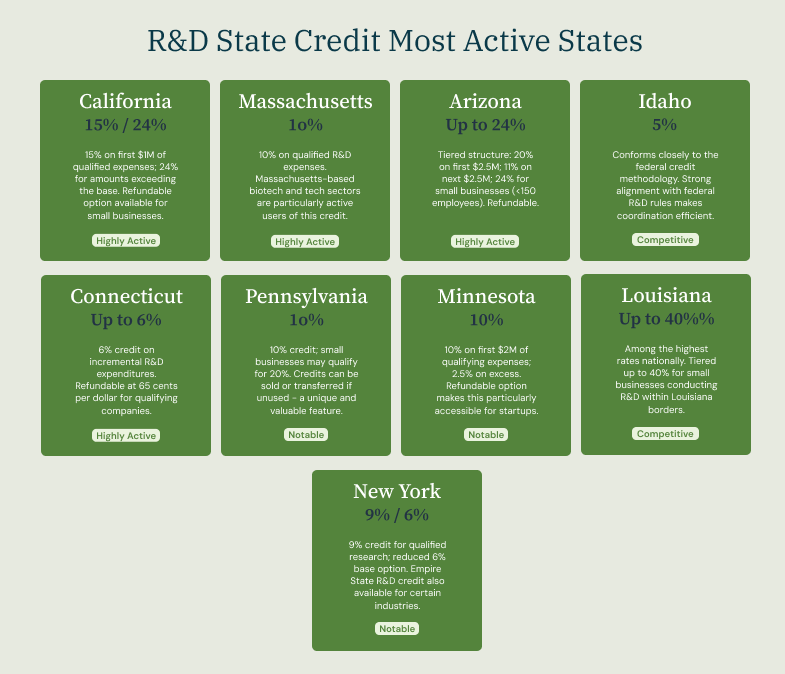
Louisiana stands out nationally for the sheer generosity of its rate structure. Small businesses conducting qualified research within the state can access credits up to 40% of their qualified research expenses, among the highest rates available anywhere in the country. Larger corporations qualify for an 8% rate on in-state QREs. The key requirement is that the research must be physically performed within Louisiana, making this credit particularly impactful for companies with in-state operations and R&D headcount.
Arizona: Up to 24%
Arizona has developed one of the more business-friendly R&D credit structures in the country. The tiered system provides 20% on the first $2.5 million in qualified expenses, 11% on the next $2.5 million, and a full 24% for businesses with 150 or fewer employees. The credit is fully refundable, which means qualifying companies can receive the benefit as a cash payment even if they don’t owe state income tax, a significant advantage for earlier-stage or capital-intensive businesses.
California: 15% to 24%
California’s R&D credit is one of the most widely utilized in the nation, driven in large part by the concentration of technology, life sciences, biotech, and advanced manufacturing companies operating there. The credit provides 15% on the first $1 million in excess qualified research expenses, with a 24% rate on amounts above that threshold. A refundable option is available for small businesses, and the state’s conformity to federal QRE definitions makes the credit relatively straightforward to calculate alongside the federal claim.
Rhode Island: 22.5% / 16.9%
Rhode Island is often overlooked in conversations about state R&D incentives, but its rate structure is genuinely competitive. The state provides a 22.5% credit on the first $111,111 of qualified research expenses and 16.9% on amounts above that. For mid-market companies with moderate QRE levels, this tiered structure can produce a disproportionately favorable result, particularly when stacked on top of the federal credit.
Vermont: 27% of Federal Credit
Vermont’s approach is straightforward: the state credit equals 27% of whatever the taxpayer’s allowable federal R&D credit is. While this structure means the state benefit scales directly with the federal claim, it eliminates the need to perform a separate QRE calculation under state-specific rules. For companies that have already done the work to substantiate a strong federal credit, Vermont’s credit can be a clean and efficient add-on.
Massachusetts: 10%
Massachusetts offers a consistent 10% credit on qualified research expenses, and it is one of the most heavily utilized state R&D credits in the country. The credit’s broad applicability across industries; particularly life sciences, technology, and advanced manufacturing; combined with the state’s deep talent base and research ecosystem, makes it a cornerstone of tax strategy for Massachusetts-based businesses. The straightforward rate and well-established administrative history make it one of the easier credits to document and defend.
Pennsylvania: 10% / 20% with Transferability
Pennsylvania’s credit is notable not just for its rates (10% for most businesses, 20% for small businesses) but for a distinctive structural feature: unused credits can be sold or transferred to other Pennsylvania taxpayers. This is especially valuable for pre-revenue companies or businesses in rapid-growth phases that are investing heavily in R&D but don’t yet have sufficient tax liability to absorb the full credit value. The ability to monetize the credit through a transfer creates liquidity that would otherwise be locked up for years.
Minnesota: 10% / 2.5% with Refundability
Minnesota provides a 10% credit on the first $2 million of qualifying research expenses, with a reduced 2.5% rate on any amounts above that threshold. Like Arizona, Minnesota makes its credit refundable for qualifying companies, which significantly broadens the practical benefit to businesses that are early in their growth cycle or operating at a loss. The refundable structure means the credit functions more like a grant than a traditional tax offset.
New Jersey: 10% with Transferability
New Jersey mirrors Pennsylvania in one important respect: unused R&D credits can be sold or transferred, providing companies with a path to immediate cash value rather than requiring them to carry credits forward indefinitely. The base rate is 10% on qualified research expenses. For New Jersey-based companies in sectors like pharmaceuticals, technology, and financial services; all well-represented in the state; this credit is a meaningful and frequently claimed incentive.
Connecticut: 6% with Refundability
Connecticut’s 6% rate on incremental qualified research expenses may be lower than some of the states listed above, but its refundable structure sets it apart. The state allows companies to redeem unused credits at 65 cents on the dollar, meaning a business that can’t absorb the full credit against its tax liability can still recover a meaningful portion in cash. For growing companies in Connecticut’s biotechnology, financial technology, and advanced manufacturing sectors, this provides a real and timely benefit.
Key Structural Features to Evaluate
When assessing state R&D credits beyond the headline rate, three structural features can significantly affect the practical value of the benefit:
Refundability means the state will pay out some or all of the credit as a cash refund even if no taxes are owed. This is critical for companies that are pre-revenue, operating at a loss, or in a high-investment phase where QREs outpace current taxable income. States with refundable credits include Arizona, California (for small businesses), Connecticut, Minnesota, and Maryland.
Transferability allows companies to sell or assign unused credits to third-party taxpayers. Pennsylvania and New Jersey are the clearest examples of this in the R&D credit space. This provision can effectively turn a deferred tax benefit into near-term working capital — a meaningful advantage for startups and capital-intensive businesses.
Conformity to federal rules determines how closely a state’s definition of qualified research expenses mirrors IRC Section 41. High conformity means companies can largely rely on their federal QRE analysis when calculating the state credit, reducing compliance burden. Low conformity means a separate, state-specific calculation is required, which adds complexity but can also create opportunities if the state’s rules are more favorable in certain areas.
Stacking Federal and State Credits: A Practical Example
Consider a mid-size manufacturer with $3 million in federal qualified research expenses. Assuming an Alternative Simplified Credit calculation, the federal credit could be in the range of $280,000 to $420,000 depending on the base period average. If that same company operates in Massachusetts, the state credit adds another $300,000 (10% of $3M). In Arizona with 150 or fewer employees, the state benefit could approach $600,000 on that same QRE base.
The combined federal and state benefit, across the right structure, can represent a substantial percentage of a company’s total R&D payroll investment, recurring and claimable every tax year.
Protecting the Claim: Why Documentation Is Everything
A generous rate means little if the credit can’t withstand scrutiny. Both the IRS and state revenue agencies have increased audit activity around R&D credits, and documentation deficiencies are among the most common reasons credits are reduced or disallowed on examination.
At CSSI, we approach every R&D credit engagement with the same engineering rigor we bring to cost segregation studies. That means contemporaneous documentation of qualified activities, clear mapping of employee time to qualified research, and support for every QRE category; wages, supplies, and contract research. The result is a credit that is not only maximized but defensible.
Is Your Business Leaving State R&D Credits Behind?
If your company is already claiming the federal R&D credit, or believes it may qualify, there’s a strong likelihood that state-level credits are also available and unclaimed. The analysis is often simpler than businesses expect, and the annual benefit can be significant.
CSSI specializes in identifying, calculating, and documenting R&D tax credits at both the federal and state level. With more than 23 years of experience and a compliance-first methodology, we help businesses capture every dollar they’ve earned without introducing unnecessary audit risk.
Request a free R&D analysis today and find out what your business may be leaving on the table.


